01 / 12 pages
Business plan
The complete restaurant story, 10 sections and a saved financial appendix.
100 KB · A4 portrait Create your plan
 BUSINESS PLAN EXAMPLE / RESTAURANTS
Meet Cedar & Saffron: a proposed neighborhood restaurant in Austin. Explore its full plan, follow the numbers and see the three documents you can create for your own business.
Fictional case · USD · January 2027-December 2029
Actual PDF pages from this example
THE IDEA BEHIND THE PLAN
In this fictional story, Maya Ellis wants to turn her kitchen and counter-service experience into an independent restaurant. Cedar & Saffron pairs Mediterranean bowls and warm pitas with office catering, using shared ingredients and a short menu.
The planning question is concrete: can a 32-seat site support its team, survive the first months of slower sales and leave enough cash to keep operating?
Cedar & Saffron is a fictional planning example. Its founder, premises, sales targets and funding are illustrative; no operating results, lease or investment are claimed.
SEE WHAT THE OUTPUT LOOKS LIKE
Download the complete sample package free. These PDFs preview bplan.ai's editorial document format. Your own project will have its own content, assumptions and page counts.
The complete restaurant story, 10 sections and a saved financial appendix.
100 KB · A4 portrait
Seven key reports with annual figures, launch funding, payback and key assumptions.
63 KB · A4 landscape
10 presentation slides with source-linked financials and the proposed fundraising request.
51 KB · 16:9 landscapeSample downloads are free. Preparing and exporting your own documents is subject to the subscription available in the application.
FOLLOW THE NUMBERS
The example keeps startup spending, funding, operating profit and cash separate. Every forecast amount below comes from the same saved financial model used in the PDFs.
Three operating years · USD · Base case
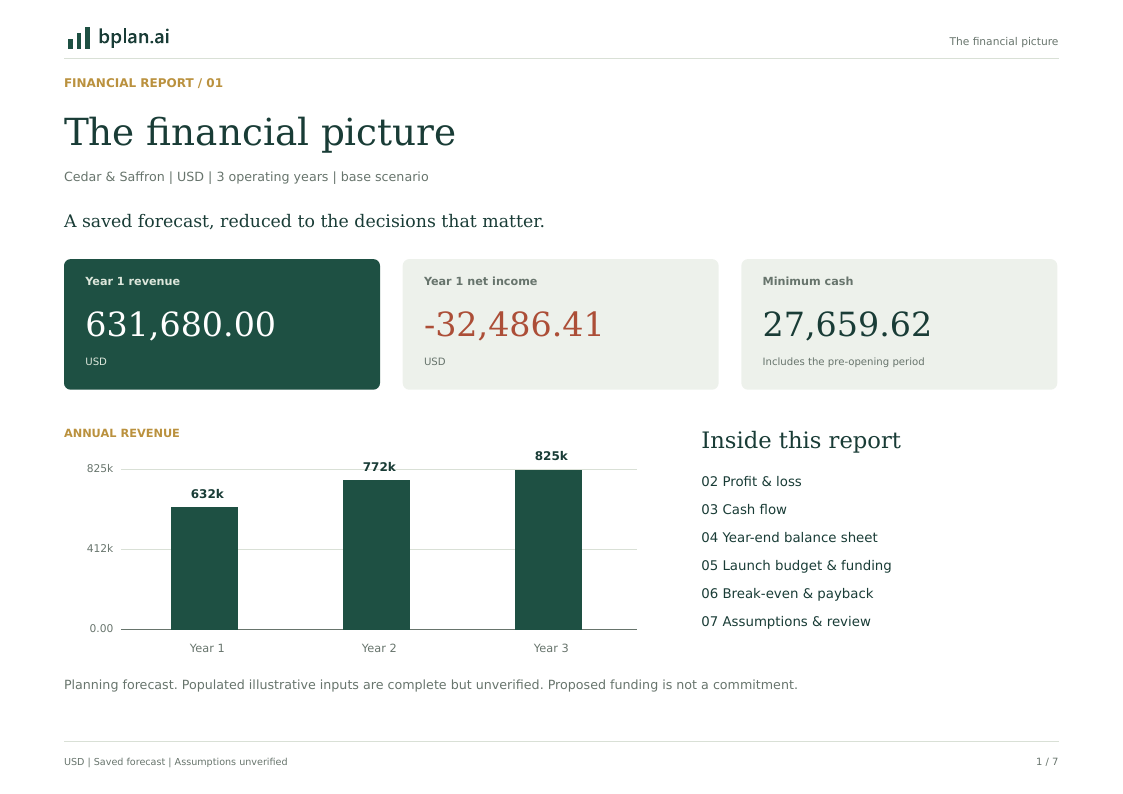
Operating EBITDA first becomes positive in month 4. At the month-4 sales mix, operating break-even is $53,053.02 per month, before depreciation, interest and income tax.
The $250,000.00 combined equity scenario leaves $66,500.00 of opening cash. Project payback is not reached within 36 months.
Inspect the complete financial PDF| Financial measure | Year 1 | Year 2 | Year 3 |
|---|---|---|---|
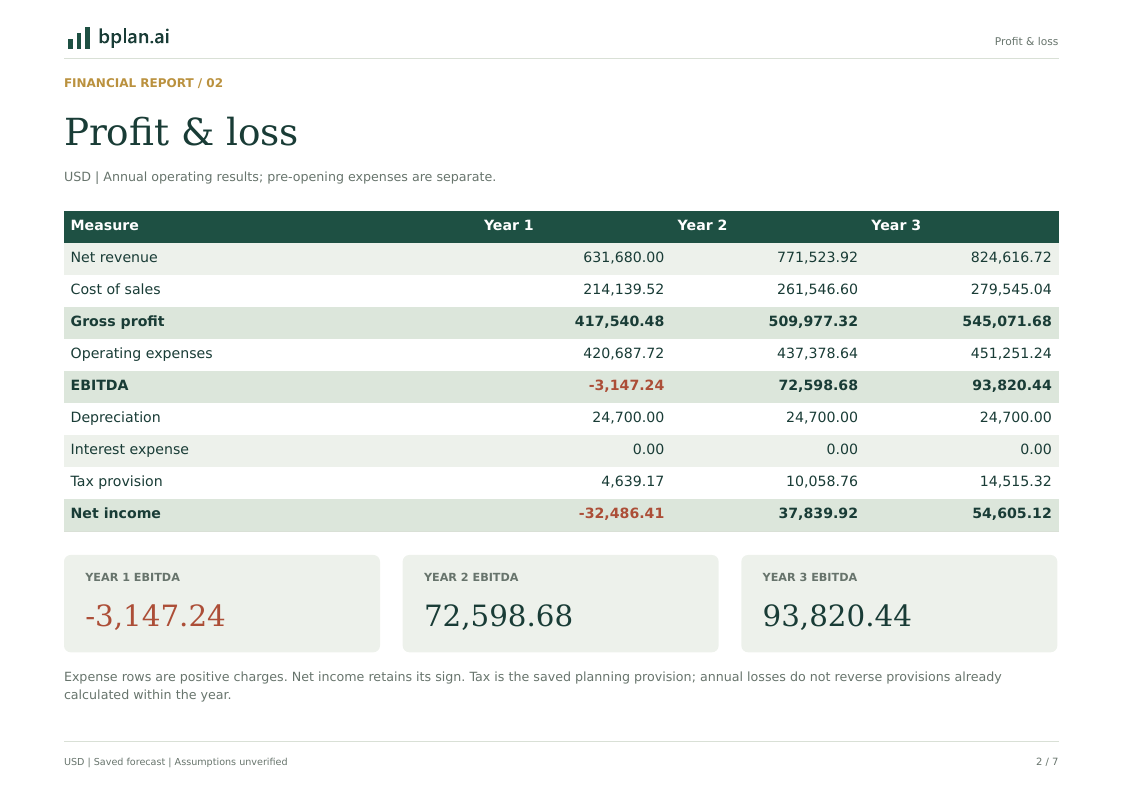
| Net revenue | $631,680.00 | $771,523.92 | $824,616.72 |
| EBITDA | -$3,147.24 | $72,598.68 | $93,820.44 |
| Net income | -$32,486.41 | $37,839.92 | $54,605.12 |
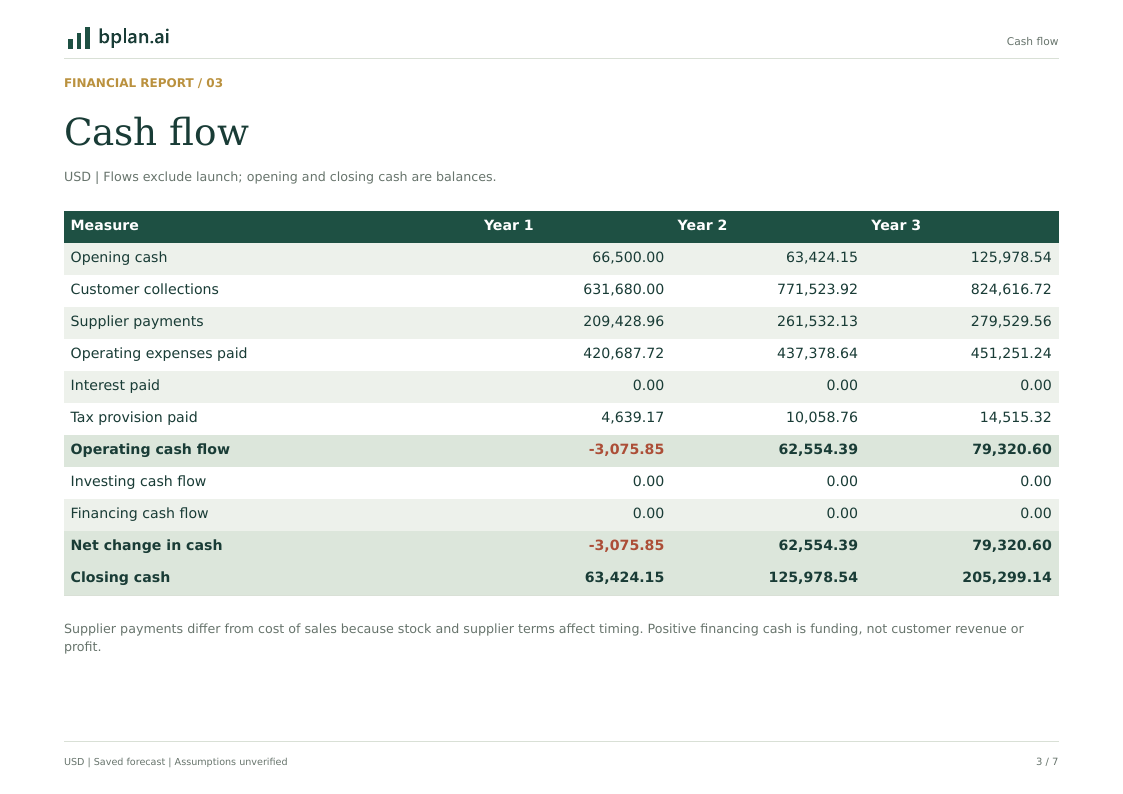
| Closing cash | $63,424.15 | $125,978.54 | $205,299.14 |
The figures are illustrative projections. The tax provision, employer costs, rent, wages and sales targets require review against actual terms. Operating break-even and investment payback are different measures.
THE 10-SLIDE PRESENTATION
These are rendered pages of the actual PDF. The financial slides resolve their numbers from the same saved forecast. Speaker notes are excluded from the PDF.
Slide 1 of 10
Fictional prelaunch example.
Customer demand remains untested.
Menu and recipe costs need paid testing.
Catchment and paid demand are not yet measured.
Year 1 forecast revenue: USD 631,680.00.
Local differentiation still needs testing.
Minimum cash: USD 27,659.62. Project payback: Not reached within 36 months.
Founder is fictional; team roles are proposed.
Sales forecasts are not actual traction.
Funding is not secured. Validate demand and terms.
WHAT YOU CAN CREATE
Start with your idea, customers and offer. Build your financial model around your prices, sales volumes, team and launch costs, then prepare your business plan and investor presentation.
This sample demonstrates the output format. It does not promise matching financial results, funding approval or a particular document length.
Create a plan like thisREAD THE COMPLETE EXAMPLE
Detailed · Clear & Professional · Investor fundraising
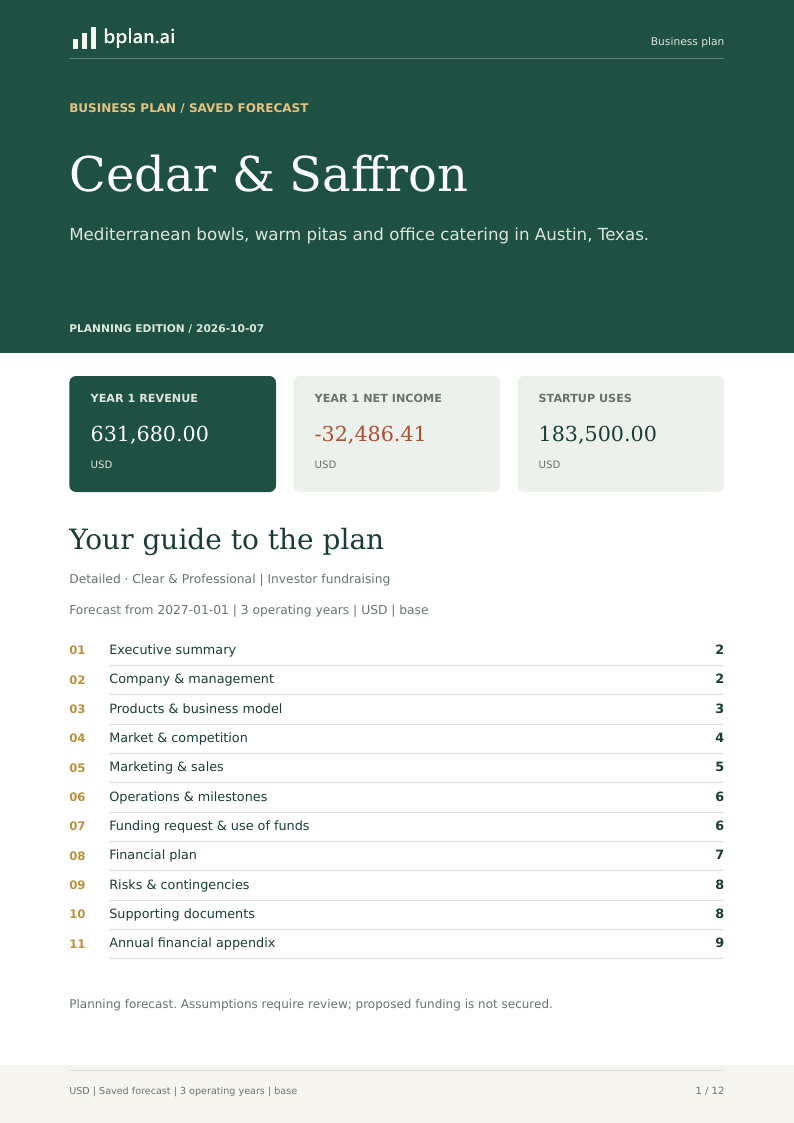
Cedar & Saffron is a fictional Mediterranean restaurant proposed for Austin, Texas. This example shows how an operating story, a saved financial forecast and a ten-slide pitch fit together. The figures describe a planning scenario, not the performance of an existing restaurant.
Cedar & Saffron would serve bowls, warm pitas and office catering from one 1,800 sq ft second-generation restaurant with 32 seats. A short menu shares ingredients across counter orders and catering. The proposed customer is a nearby worker or resident who wants a complete meal through counter service or direct pickup. The fictional founder, Maya Ellis, works as general manager; owner compensation is already included in payroll.
The first priority is to validate repeat lunch demand before signing an unconditional lease. The proposed team would test recipes, complete supplier costing and run paid pop-up lunches, then assess a small number of viable restaurant sites. Opening is modeled for January 2027 after a proposed 12-week preparation period. Sales ramp over four operating months. A second location is outside this plan.
The saved base case proposes $250,000.00 of combined equity. Startup spending is $183,500.00, leaving $66,500.00 of opening cash. First-year revenue is $631,680.00 and first-year net income is -$32,486.41. Operating EBITDA becomes positive in month 4; minimum modeled cash is $27,659.62. Pre-tax project payback is not reached within the 36-month forecast.
The company is presented as an independent, single-location prelaunch venture. The scenario is deliberately narrow enough to connect daily operating decisions to one financial model.
The fictional business would operate in Central Austin, within the City of Austin jurisdiction. No specific address, lease, entity registration or permit is claimed. The assumed second-generation premises already have a restaurant shell; a site needing a new hood, grease interceptor, major plumbing or structural changes would require a revised budget. The planning currency is USD and the first operating month is January 2027.
Maya Ellis is an invented working founder used to make the example concrete. The scenario assumes six years of kitchen and counter-service experience, including shift scheduling and purchasing. This is a fictional biography, not an independently verified credential. Maya would own the operating decisions, supplier approval, staffing and cash review. An outside equity partner is proposed, but ownership percentages, valuation, distributions and governance terms have not been specified.
The budget includes a working owner/general manager, one lead cook, one line cook, two full-time counter staff and one part-time prep/dish role. Cooks and counter staff are modeled at 40 paid hours per week; prep/dish at 20. The owner plans to work about 45 hours per week. The 15% employer-cost allowance is added once to each role. The team would stagger shifts around lunch and early dinner; the schedule needs a detailed coverage check before hiring.
The offer combines a focused everyday menu with preordered office meals. These are two separately modeled revenue streams served from the same kitchen.
The proposed menu has chicken, falafel and roasted-vegetable bowls, warm pitas, hummus, a small set of sides and non-alcoholic drinks. Ingredients overlap across recipes to keep purchasing and preparation manageable. Signature combinations make ordering quick; a limited build-your-own option accommodates preferences. Catering uses the same recipes, with labeled portions and pickup or local delivery arranged in advance. No alcohol or third-party delivery platform is included.
The counter stream assumes 130 transactions per open day at an average realized basket of $17.00, excluding customer sales tax. The restaurant is modeled as open 26 days per month, with capacity for 200 counter transactions per day. Catering assumes 5 events per month with 30 paid meals per event at $18.00 per meal when the four-month ramp is complete. These inputs produce $60,160.00 of combined monthly revenue in month 4, directly from the saved forecast.
The proposed value is a dependable, clearly priced meal with direct ordering and familiar options for office groups. A compact menu should make recipe costing, portion control and staff training easier. These benefits are hypotheses to test with paying customers. The financial case does not assume that menu variety, branding or positive feedback alone will produce the required daily volume.
Austin is the proposed location, but this plan does not claim a measured local market size or established customer traction. Published market context is separated from the demand assumptions.
The initial segments are nearby workers buying weekday lunch, residents buying an early dinner or pickup meal and office administrators arranging group lunches. The proposed catchment is a short trip from the eventual site, rather than the whole Austin metropolitan area. Customer interviews should identify buying frequency, acceptable total spend, pickup timing and alternatives. The owner should select a site only after checking visibility, access, parking or walkability against these specific buying occasions.
The forecast target of 130 counter transactions per day has not been observed. Before a lease commitment, the proposed validation is a sequence of paid pop-up lunches and catering trials, with transaction records and customer follow-up. The test should measure actual basket value, ingredient cost, preparation time and repeat orders. Traffic counts and office introductions can support site selection, but neither is evidence of restaurant sales. No survey results, waitlist, advance orders or signed catering agreements are invented here.
Mediterranean bowl and pita concepts, including CAVA, establish a recognizable product category; other fast-casual lunch offers compete for the same meal occasion. S4 is used only to identify the category, not to infer competitor pricing or market share. Cedar & Saffron proposes a neighborhood focus and preordered office catering. A field review must compare the actual nearby alternatives, menu prices, service speed and pickup experience before claiming a competitive advantage.
The saved model allocates $900.00 per month to local marketing in the first operating year. This is a spending allowance; no achieved acquisition cost or channel return is assumed.
The proposed launch channels are an accurate local-search listing, direct pickup ordering, introductions to nearby office administrators, paid sampling sessions and referrals. The owner would start with a limited number of channels and tag offers so that paid transactions can be linked to activity. Office visits should focus on a practical catering offer, lead time, portions and pickup arrangements. The team should track repeat buyers rather than treating social followers as customer demand.
Counter customers would order and pay at the point of service or through a direct pickup system. Office catering would be confirmed in advance, with payment on or before collection. The cash forecast assumes zero collection days across both streams; extending invoice terms would require an explicit working-capital change. The 2.6% payment-processing allowance is modeled separately from food cost. Customer sales tax is excluded from revenue. No subscription, marketplace remittance or platform commission is inferred.
The proposed retention process is consistent food, accurate orders, a simple reorder link and follow-up with office buyers. The owner would review transactions by daypart, average basket, repeat orders, waste and catering conversion each week. A loyalty offer should be costed before introduction; discounts are currently zero in the model. Channel spending can be redirected after evidence appears, but a forecast improvement should not be claimed before the related input changes are saved.
The proposed operating design uses one production kitchen, one counter and direct pickup, with catering prepared outside the most crowded counter periods.
The assumed 1,800 sq ft site has 32 seats and opens Monday-Saturday, 11 a.m.-8 p.m. Monthly base rent is $4,500.00, plus $750.00 NNN/CAM. S2 provides Central Austin asking-rent context; this is not a lease quote. Assets cover refurbishment, kitchen equipment, furniture, POS and signage. Ventilation, grease, power, accessibility and restrooms need site-specific review.
Daily work covers preparation, lunch assembly, restocking, dinner and closing checks. Seven days of modeled ingredient coverage supports purchasing; freshness determines actual stock levels. Assumed counter capacity is 200 transactions daily and 6,500 monthly; catering targets five 30-meal events. Trial service must verify throughput, workload and the shared kitchen schedule.
The illustrative 12-week preparation period starts with paid menu tests and site inspection, then conditional lease terms, contractor quotes, layout and permits, hiring and training. A soft opening precedes normal service. S1 identifies the pre-opening inspection and operating permit. Actual approvals and site work determine the opening date; the proposed schedule is not guaranteed.
The launch assumes proposed equity, without a loan or any secured funding.
Saved startup uses total $183,500.00: $157,000.00 assets, $22,000.00 expensed setup and $4,500.00 ingredients. Assets allow $75,000 refurbishment, $58,000 kitchen equipment, $18,000 furniture and $6,000 POS/signage. Setup allows $1,326 published Austin health fees, $10,500 pre-opening occupancy, $6,500 training/tests and $3,674 professional preparation. Deposits and extra site work need separate quotes.
The saved equity input of $250,000.00 combines $80,000.00 proposed founder funding and $170,000.00 external equity. Both are assumed at month 0; neither is committed or received. These cash inflows are financing, not restaurant revenue or profit.
The $80,000.00 owner contribution is fictional; available funds need confirmation. Founder salary is already in operating expenses and must not be added twice.
The $170,000.00 external request plus owner funding leaves $66,500.00 opening cash. Minimum modeled cash is $27,659.62; the $0.00 unfunded gap applies only to this funded scenario. The request differs from that gap. Valuation, ownership, distributions and exit terms remain unspecified.
One saved forecast covers January 2027-December 2029. Prelaunch month 0 appears separately in the reports.
The four-month ramp targets 130 daily orders on 26 days at $17.00, plus 5 monthly 30-meal catering events at $18.00. Ingredients are 32.4% of sales (dated proxy S3); packaging adds 1.5% and processing 2.6%. Employer costs are 15%, stock and supplier terms seven days, collection zero days and tax provision 21%. The saved model retains every input and growth assumption.
Revenue is $631,680.00, $771,523.92 and $824,616.72 in years 1-3; net income is -$32,486.41, $37,839.92 and $54,605.12. The first-year loss reflects the sales ramp with ongoing staffing costs. These years exclude $22,000.00 of prelaunch expense. Annual reports use the saved run, which retains all monthly rows.
Operating EBITDA turns positive in month 4. Month-4 operating break-even is $53,053.02 per month, excluding depreciation, interest and income tax. Minimum cash is $27,659.62; year-1 closing cash is $63,424.15. Depreciation and working-capital timing separate profit from cash. Pre-tax project payback is not reached within the 36-month horizon.
No loan, interest or principal repayments are modeled. Future borrowing requires actual terms and a new forecast; the current case establishes no lending approval or guaranteed return.
The main risk is entering a fixed-cost lease and staffing commitment before proving sufficient repeat demand. The positive cash result depends on the full proposed funding contribution and the saved assumptions.
A slower lunch ramp could absorb the opening cash buffer. Menu waste, packaging usage and ingredient-price changes could reduce the contribution margin. A site requiring major work could exceed the refurbishment allowance or delay opening. Shift gaps could increase labor cost or restrict service. Catering introduces coordination demands even though it shares recipes. The forecast also omits refundable deposits, third-party delivery, owner distributions and expansion; adding them requires explicit model inputs.
The proposed response is a conditional site decision after paid tests, a limited menu with recipe costing, a written contractor scope and a weekly cash review. The owner should separately test weaker sales while holding payroll and fixed costs constant, then assess whether the cash reserve covers the result. Reducing the team, changing the site or raising prices are decisions to model and validate, not assumed automatic fixes. Expansion should wait for repeat demand and sufficient cash after the first site stabilizes.
The available material is the fictional case description, its saved financial input/output, this business-plan text, the ten-slide pitch and the dated public references below. No actual business records are supplied.
The package contains a detailed business-plan PDF, an independent financial-report PDF and a ten-slide pitch-deck PDF. All financial statements and linked pitch values share the same saved source. The planning basis is fictional and all funding remains proposed. The public sources provide limited context; they do not verify the restaurant, its wages, equipment prices or demand.
S1: City of Austin. Austin Public Health: Fixed Food Establishments. Period: Current page retrieved October 7, 2026. Retrieved 2026-10-07. https://www.austintexas.gov/health/programs/fixed-food-establishments S2: Partners Real Estate. Austin Retail Market Report, Q1 2026. Period: Q1 2026; table on page 5. Retrieved 2026-10-07. https://partnersrealestate.com/wp-content/uploads/2026/05/Q126_Austin_Retail_QuarterlyReport-1.pdf S3: National Restaurant Association. Restaurant operators kept food cost ratios in check in 2024. Period: 2024 respondent financial data; published in 2025. Retrieved 2026-10-07. https://www.restaurant.org/research-and-media/research/restaurant-economic-insights/analysis-commentary/restaurant-operators-kept-food-cost-ratios-in-check-in-2024/ S4: CAVA. CAVA menu. Period: Current menu page. Retrieved 2026-10-07. https://cava.com/menu
Before a real launch, obtain paid-test transaction records, supplier recipe and equipment quotes, a site inspection, a contractor scope, actual lease and deposit terms, a coverage-based staffing schedule, entity and tax advice, permit confirmations and funding documentation. Customer letters or catering orders should appear only if actually obtained. This example contains no permit certificate, signed contract, fabricated customer quote or proof of approved financing.
RESEARCH AND ASSUMPTIONS
Sources checked October 7, 2026. Published context is distinguished from the unquoted and untested inputs of this fictional business.
City of Austin remodel plan review below 2,500 sq ft: $221; pre-opening inspection: $178; operating permit at $150,000+ annual sales: $927, renewed annually.
These three published fees total $1,326 and are included within the illustrative setup budget. Building, fire, design and other site-dependent costs are separate allowances. Confirm jurisdiction, classification and fees for the actual premises.
Central submarket average asking NNN rent: $28.95 per sq ft per year; metro total: $26.40.
Market context only. The example assumes $30 per sq ft per year for 1,800 sq ft, plus $750 monthly NNN/CAM. These are planning inputs, not a quoted, signed or net-effective restaurant lease.
Median food and non-alcohol beverage cost was 32.4% of sales among limited-service survey respondents.
A disclosed starting assumption for ingredient cost, not a standard or a forecast of this restaurant. Packaging and payment processing are additional, separately modeled expenses. Supplier recipes and actual waste must replace this proxy.
Mediterranean bowl and pita menu category.
Category competition context only. No competitor price, local customer count or market share is inferred. The $17 average counter transaction is an illustrative basket assumption.